
Home décor trends may come and go (perhaps you’ve heard cabbagecore and skirted furniture are having a moment). But one thing that’s never out of style in home textiles is comfort. Add an increasing emphasis on natural, breathable fibers and it’s clear why cotton textiles continue to be the premier choice for beds, baths, and beyond.
Grace Grant, founder of Evergrace Home, says the majority of the company’s products are made with cotton or other natural fibers.
For us, choosing cotton is about delivering quality and longevity, products that feel better and perform well over time.
Grace Grant, Founder, Evergrace Home
“Our collections focus on bedding and soft home décor, including quilts, coverlets, sheet sets, duvet covers, bed blankets, throws and decorative pillows, where comfort, breathability and durability are especially important,” Grant told the Lifestyle Monitor™in an interview. “Cotton remains a foundational fiber for us because it delivers the natural softness and everyday performance customers expect in products used in the home.”
Cotton is also the predominant fiber for Garnet Hill products, says Millie Abernathy, senior director, divisional merchandise manager.
“Nearly all of our home products are 100 percent cotton, and we’re pretty particular about which cotton,” Abernathy told the Lifestyle Monitor™ in an interview. “Garnet Hill was built on natural fibers – it’s our origin story. Our founders came back from Europe with a cotton flannel sheet they couldn’t find anywhere in the U.S., and the whole company grew from that.”
“So, cotton isn’t something we arrived at, it’s where we started,” Abernathy continued. “And our customers feel the difference. It’s softer, it breathes, it gets better with every wash. Comfort and quality are what our customer is after, and cotton just delivers that in a way synthetics don’t. And beyond that, there’s a real environmental benefit we feel good about: when a natural fiber product reaches the end of its life, it can decompose and return to the earth in a way synthetic materials simply cannot. That matters to us.”
It matters to consumers, as well. Consider that nearly 3-in-5 consumers say sustainability influences their home textiles purchase, according to Cotton Incorporated’s 2026 Global Sustainability Survey of 1,022 U.S. respondents.
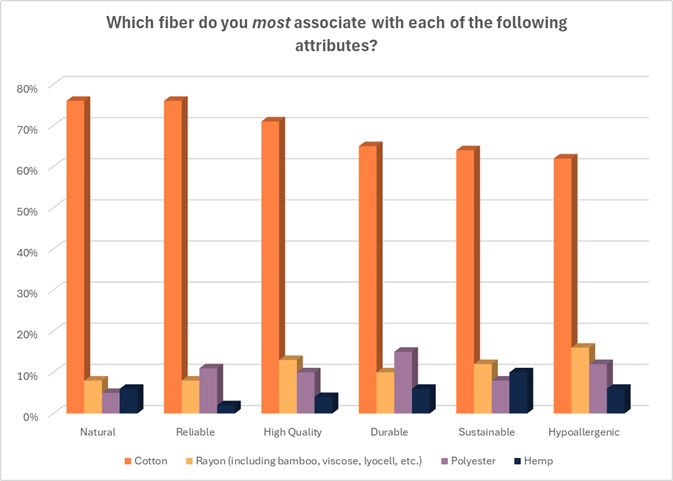
American consumers overwhelmingly say organic cotton (82 percent), recycled cotton (80 percent) and conventional cotton (78 percent) are safe for the environment, according to the 2026 Global Sustainability Survey. Further, shoppers say cotton is the most natural (76 percent), sustainable (64 percent) and highest quality (71 percent) fiber. And nearly two-thirds (63 percent) say cotton fibers do not contribute to microplastic pollution, according to Cotton Incorporated’s 2025 Microplastics Survey of 969 U.S. respondents.
“Sustainability is core to how we think about product development, and it starts with renewable natural fibers,” Abernathy said. “We limit the use of synthetics because we believe that there is no greater quality or comfort than what nature provides.”
One example of how brands are responding to this consumer demand is the recent collaboration between 1888 Mills and Cotton Incorporated, which introduced a 100% cotton bath and bedding collection featuring the Seal of Cotton trademark. Developed to offer a natural alternative at opening price points, the line provides consumers an accessible way to choose cotton products engineered for everyday comfort and long-lasting quality, while also addressing concerns about microplastics and synthetic materials.
“Our goal was to create a collection that’s truly affordable and accessible, while giving consumers more opportunities to choose natural fibers,” said Lexi Schladenhauffen, chief merchandising officer at 1888 Mills. “We worked with Cotton Incorporated to highlight the benefits of natural cotton fiber, such as softness, breathability, and durability…and believe that towels and sheets, the fabrics we live closest to, should be as clean, natural, and comfortable as possible.”
A “consumer preference for natural, breathable fibers amid growing health and environmental consciousness” is expected to expand the cotton segment of the global home textiles market at a CAGR of 6.9 percent by 2034, according to Market Data Forecast. Overall, the market size was valued at $132.85 billion in 2025 and is expected to reach $224.83 billion by 2034.
Evergrace’s Grant says sustainability is an important part of how the company thinks about the materials it chooses.
“Plant-based fibers like cotton offer a natural alternative to petroleum-based materials, which is increasingly meaningful as consumers become more mindful of what their home products are made from,” Grant said. “We’re seeing growing interest from customers who care about fiber content and want products that feel intentional and responsible.”
Besides being drawn to cotton’s sustainability features, nearly 8 in 10 consumers (79 percent) consider cotton to be the softest fiber, according to Cotton Incorporated’s 2026 Lifestyle Monitor™ Survey, of more than 400 respondents. As it stands, cotton is the preferred home textiles fabric for bath towels (69 percent), sheets (55 percent), and bedspreads (55 percent).
Nearly three-quarters of all consumers (72 percent) say cotton bath towels are the most comfortable to use, according to the Monitor™ research. A majority (57 percent) also say cotton towels are the healthiest to use. Another 60 percent say cotton bed sheets are the most comfortable. And 62 percent of U.S. shoppers say they’re likely to look for bed sheets that keep them cool.
Innovations include technologies such as RESTech COTTON™, TOUGH COTTON™,and TransDRY® Technologies, all of which boost temperature regulation and support restful sleep. For instance, RESTech COTTON™ Technology seamlessly blends cool comfort, exceptional durability, and gentle softness, all while prioritizing sustainability. Initially tested for bed sheets, this versatile technology can also be adapted for top-of- bed products, including duvets and blankets. TransDRY® Technology wicks moisture, dries faster, and increases comfort for woven and knit bedding.
Cotton’s natural breathability and comfort will maintain it as the preferred textile option for Evergrace’s product offering.
“In bedding and soft home décor, cotton offers qualities that are difficult to replicate with synthetic fibers,” Grant said. “It is naturally breathable, soft against the skin and highly durable, making it ideal for products people use every day. It also has excellent moisture-absorbing and temperature-regulating properties, which help create a more comfortable sleeping environment. For us, choosing cotton is about delivering quality and longevity, products that feel better and perform well over time.”