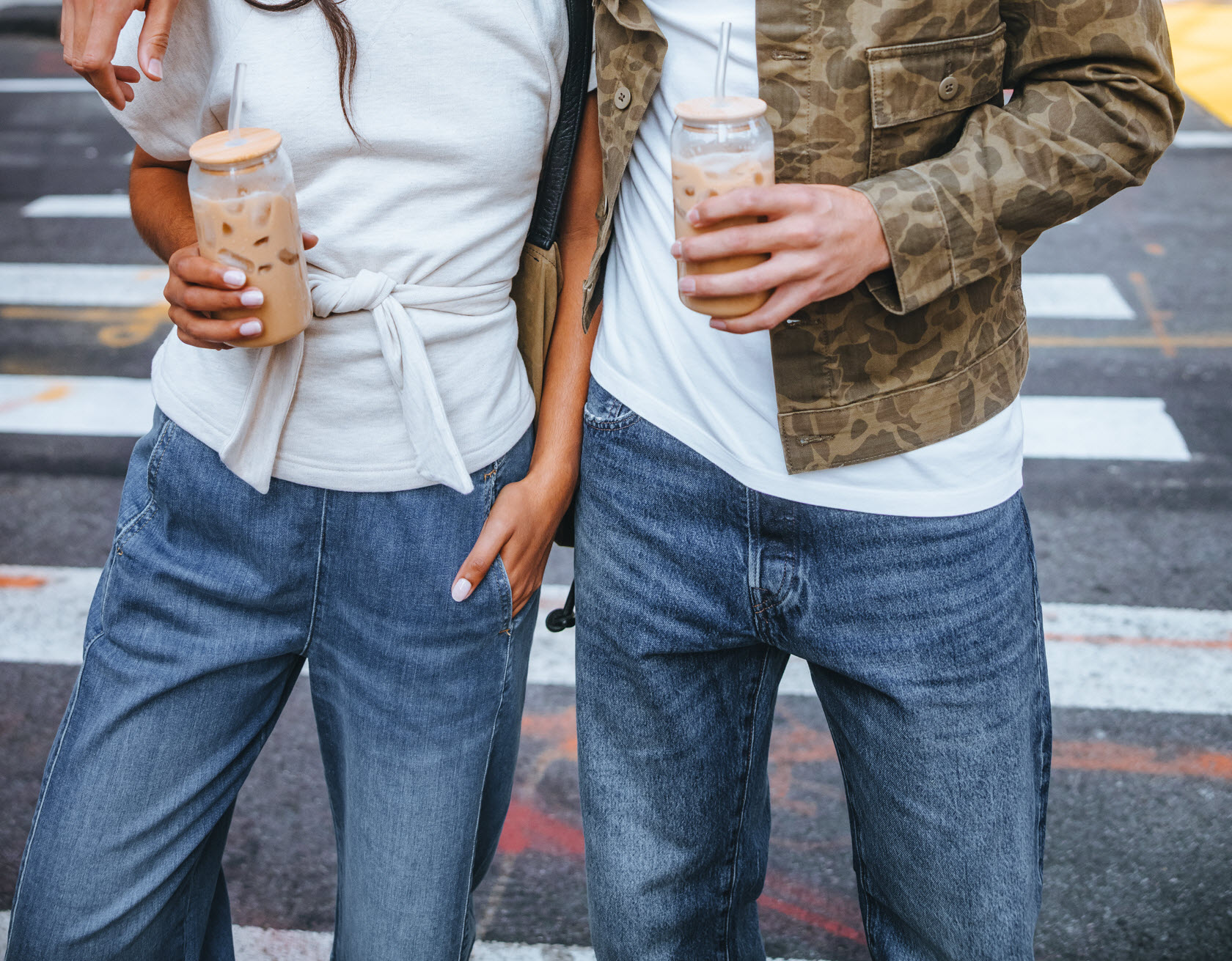
Every May 20th marks a day to be celebrated in the denim world: It’s the birthday of the blue jean. This year, brands are turning out an abundance of newness as consumers still emphatically embrace the heritage bottom and sustainability continues to grow in importance.
Trendalytics’ Cate Khan, CEO of the retail analytics platform, says denim maintains both designer and consumer engagement because it’s always evolving.
“A big part of the appeal is how it changes over time,” Khan told the Lifestyle MonitorTM in an interview. “For designers, that’s what keeps it interesting. Denim is familiar, so people feel comfortable buying into it, but it also gives brands room to play with new silhouettes, finishes and details each season without pushing consumers too far out of their comfort zone.”
Incredibly, modern denim jeans bear a great resemblance to the originals, whose birthday is May 20, 1873. That was the day Levi Strauss and Jacob Davis obtained a U.S. patent on the process of putting rivets in men’s denim work pants. As history tells it, Strauss was a dry goods merchant in San Francisco at the height of the gold rush. Davis was a tailor and one of Strauss’s customers. One day, the wife of a local laborer came to Davis, asking if he could make pants that wouldn’t fall apart. Davis designed denim pants with metal rivets at points of strain, like the pocket corners and button fly. An instant success, Davis thought to take out a patent on the product, but he needed a partner to scale the manufacturing. That’s when he turned to Strauss and the pair received their patent for “Improvement in Pocket-Openings.”
An entire category of apparel has grown from those humble beginnings. The North American denim jeans market was valued at $27.5 billion in 2025 and is expected to reach $47.6 billion by 2033, according to Data Bridge Market Research. Globally, the denim jeans category is expected to capture a market size of $121.7 billion by 2030, according to Research and Markets.
On average, consumers who own denim say they wear their jeans or denim shorts three days a week, according to Cotton Incorporated’s 2026 Lifestyle MonitorTM Survey of 470 respondents. Denim jeans were also the topmost frequently worn bottoms over the previous month (43 percent), according to Cotton Incorporated’s January 2026 Consumer Sentiment Survey, Wave 6, of 984 respondents. This was followed by sweats or pajama pants (39 percent) and athleisure bottoms (29 percent).
Denim jeans are so popular that just over two-thirds of all consumers (67 percent) – and 73 percent of men – say they prefer to go places where they can wear jeans, according to the MonitorTM research. Consumers say they’d likely wear jeans when spending time with friends or family (81 percent), going out to dinner (74 percent), running errands or shopping (72 percent) or traveling (67 percent).
Lee Jeans’ Vivian Rivetti, vice president, global design, says the durability and quality of the fabric make denim a foundation for daily wear.
“As customers look for more comfort or new wear occasions, designers and brands will find new ways to address those demands,” Rivetti told the Lifestyle MonitorTMin an interview. “Every season, we find ways to make it feel fresh, whether that’s through new fabrications, wash techniques or styles.”
The widespread opportunities to wear denim have created extensive style options. Future Snoops’ Julia Skliarova, director of materials at the trend forecasting agency, says there isn’t a singular trend currently influencing denim.
“The top-down denim trend has broken down and what’s replacing it is consumer-led, highly individualized style,” Skliarova told the Lifestyle MonitorTM in an interview. “Previously, denim used to move in slower, collective cycles. Now it’s fragmented. The power has shifted from brands to consumers, and the fragmentation of social media has created micro-communities of consumers seeking different denim looks, driven by different identities and values.”
Future Snoops’ Robbie Sinclair, vice president of fashion, agrees.
“I’ve worked in the fashion industry for almost 20 years and for the first time in my memory there is no standout silhouette within denim, which I find really interesting,” Sinclair told the Lifestyle MonitorTM. “We’re seeing all shapes take center stage. There is a slow return to slimmer styles, which feels like a safety net for Millennials who carry a fondness for the skinny. Wider silhouettes are still continuing with barrel or curved seams gaining momentum, even after a few seasons. Consumers are braver with denim.”
Lee, another heritage brand that was founded in 1889, is meeting customer demand with a variety of fabrics and fits, including a collaboration with Feng Chen Wang that’s yielding a deconstructed, avant-garde collection; clean classics via a collab with J. Crew; super soft, liquid-like denim; stiff, premium Cordura denim; and wide-leg, barrel-leg, bleach splattered and lace detailed pieces – among others.
“Whether it’s a classic style – like a straight or bootcut – or a newer one like a barrel jean for men or a kick flare for women, denim in general is trending,” Rivetti said. “There is also a focus on balancing softness and durability.”
Durability is a key component of sustainability, and consumers overwhelmingly want denim that will last a long time (86 percent), according to MonitorTM research. However, many also look for jeans made of natural fibers (70 percent), plastic-free materials (59 percent), recyclable (48 percent) and without the use of chemical treatments in the finishing (46 percent).
More than 7 in 10 consumers (72 percent) prefer denim jeans made from 100 percent cotton or a cotton blend, according to MonitorTM research. Shoppers in the U.S. see 100 percent cotton jeans as the healthiest to wear (68 percent), most authentic (67 percent), most sustainable or environmentally friendly (64 percent) compared to jeans made from cotton blended with other fibers.
Skliarova says sustainability is a key area of denim development.
“Cutting back on waste and resources is promising to deliver real impact, and prepare manufacturers and brands for oncoming legislations and mandates, such as the EPR (Extended Producer Responsibility), toxic substances and PFA (polyfluoroalkyl) bans,” Skliarova said, “as well as anti-greenwashing regulations. New wash and treatment technologies are cutting down water and dye usage, while chemical by-products are phased out and entire processing steps are eliminated with cleaner finishes like enzyme-dyeing.”
Khan says the conversation is shifting toward how long denim lasts and what happens at the end of a garment’s life.
“You’re seeing more focus on things like upcycling, resale, take-back programs and using deadstock fabrics, especially with younger consumers,” Khan said. “Recycled denim alone has over 8 million views on TikTok, up 49 percent year over year, which shows people are paying attention to how denim is being reused and reworked.
“At the same time, brands are still investing in how denim is made,” Khan continued. “There’s more happening around waterless dyeing and lower-impact finishing, but it’s being done in a way that doesn’t take away from how denim looks or feels. At the end of the day, people still want that same worn-in, lived-in quality – just with a little more intention.”