Earth Day 2026 just wrapped its global celebration with the theme “Our Power, Our Planet,” encouraging people of all backgrounds and generations to “stand shoulder to shoulder in defense of the only home we share.”
Of course, EarthDay.org encourages participants to continue taking action and showing “your love for Planet Earth” throughout the year. One way apparel consumers can do just that is by eschewing apparel which contributes to microplastic pollution and instead embrace clothing made with natural fibers like cotton.
That’s where brands like Jiwya, a 100 percent plant-based apparel maker, and Stewards, a high-performance apparel brand made from recycled cotton and aloe vera, come in.
Cotton was the answer for us because it was the most honest one…We’re closing the loop on what’s already here.”
Brandi Andres, Chief Marketing Officer, Stewards
Stewards, founded by David Allyn, CEO, and Brandi Andres, CMO, is challenging the industry belief that performance requires synthetics. On Earth Day, the Los Angeles-based company launched its second drop, a collection that features its proprietary AV MAXTM technology, which is a 100 percent recycled cotton fiber infused with aloe vera. The technology helps regulate temperature, reduce odor and cut down on the need for frequent washing, thanks to natural antibacterial properties.
“The aloe infusion also means the fabric naturally controls odor between washes, which matters for circularity in ways most of us don’t think about,” Allyn told the Lifestyle Monitor™ in an interview. “Fewer washes mean less water use, lower energy use, and reduced wear on the fiber over time. So, the garment can stay in use longer. That’s the self-reinforcing system we were after, and because the base is natural cotton, it’s biodegradable at end of life.”
Meanwhile, Jiwya, founded by textile scientists Aishwarya Lahariya and Adhiraj Shinde, bills itself as a “solution to the many woes of fashion.” The pair left careers in the U.S. to journey across India, and rethink what fashion could look like while challenging the industry’s reliance on petroleum-based textiles like polyester.
“Our soil-to-soil ecosystem is designed to be bio-circular, and intentionally slow and closed loop,” said Jiwya’s Lahariya, co-founder and designer, in an interview with the Lifestyle Monitor™. “Indigenous varieties of cotton became a major part of our plant-fibers. Varieties like Kala cotton that grows in drought-prone areas are a staple because they are inherently a response to the warming planet. We call it the fiber of the future.”
The cotton industry is at the forefront of creating sustainable textiles, with opportunities for environmental improvement and resource conservation sewn right into the cotton life cycle. Cotton growers today are using more efficient irrigation systems, crop inputs and technologies while increasing the amount of cotton produced per acre. For instance, 64 percent of U.S. cotton requires no irrigation, relying instead on rain fall, 31 percent receives supplemental irrigation and only 5 percent is fully irrigated.
Further, cotton is inherently circular. Not only can it be reused and recycled, but, as Stewards’ Allyn stated, at the end of a garment’s life, it can return to the earth through biodegradation because it’s cellulose based.
This type of eco-consciousness and effort to improve sustainability is likely appreciated by today’s U.S. consumers, considering fully 76 percent say they’re motivated to take environmentally friendly actions themselves, up from 73 percent in 2023, according to the 2026 Cotton Council International & Cotton Incorporated Global Sustainability Survey of 1,000+ respondents. Their top reasons include simply believing it is the right thing to do (41 percent), to protect the world for future generations (39 percent), fear for what will happen to the environment “if we don’t change course” (33 percent) and the aim to live a healthier and more balanced lifestyle (30 percent).
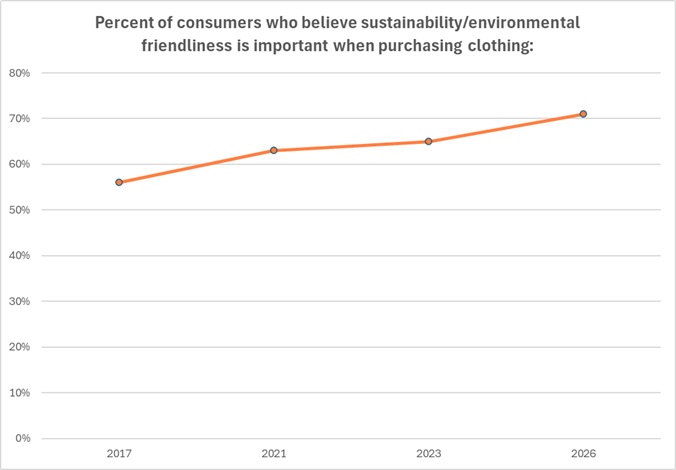
Further, 71 percent of U.S. consumers believe that sustainability is important when purchasing apparel, a significant increase from 65 percent in 2023, according to the 2026 Global Sustainability Survey. More than three-quarters (76 percent) say fabric is very important, extremely important, or absolutely essential in determining the level of a garment’s sustainability. And 76 percent will look for clothing made from natural fibers like cotton.
Circularity in fashion also has to do with renewing and reusing what already exists. LiquiDonate is a San Francisco-based software company, that positions itself as a “simple returns and warehouse management solution,” meaning it routes non-sellable returns from retailers directly to non-profits and communities in need, reducing waste and the amount of product that ends up in landfills.
“You can’t talk about sustainability without addressing returns, overproduction and what happens to product after the sale,” said LiquiDonate’s Disney Petit, founder and CEO, in an interview with the Lifestyle Monitor™. “A significant percentage of goods, especially in fast fashion, are returned, liquidated or discarded because there isn’t a scalable system to handle them otherwise. If reverse logistics isn’t part of the strategy, you’re not addressing the biggest driver of waste in the business.”
Circular Club is also tackling apparel waste, only it focuses on children’s clothing. Parents can pick up to five “gently loved” pieces of apparel per month. When the child outgrows the garments or to simply refresh their wardrobe, the items are returned to swap for a fresh selection of “new to you” pieces, extending the life of the clothes while reducing waste.
Another consumer concern: microplastic pollution, which stems in part from petroleum-based fibers like polyester, nylon, and acrylic. Many U.S. shoppers (41 percent) have major concerns about wearing clothes containing microplastics, according to Cotton Incorporated’s 2025 Microplastics Survey (n=969). And nearly 6 in 10 (59 percent) say they’re likely to look for apparel made with microplastic-free fibers, per the Global Sustainability research. Most consumers (63 percent) say cotton does not contribute to microplastic pollution.
But barriers still exist, making it difficult for consumers to take more action against microplastics. Consumers say there is a lack of clear information or guidance on the issue (37 percent), they are unsure what actions to take (36 percent), there are not enough environmentally-friendly options (31 percent), there is conflicting information about what to do (20 percent) and actions seem too expensive (20 percent), according to Cotton Incorporated’s 2026 Health, Athleisure and Microplastics U.S. Survey of 363 respondents.
To combat microplastic pollution, consumers say the industry needs to reduce plastic packaging (72 percent), switch from synthetic to natural materials (64 percent) and employ recycling and collections at the end of life (61 percent), according to the 2026 Health, Athleisure and Microplastics Survey.
Jimya’s Lahariya says what fashion needs today “is a conscience.”
“Jiwya started because fashion needs change,” Lahariya explained. “This change for us is our soil-to-soil ecosystem. Being 100 percent plant-based is our very foundation to avoid all animal and plastic material in our entire supply chain. It has seeped within every inch of our atelier, and everything is vetted to ensure it does not use any plastic or animal products, only plants. The natural feel of a fiber is what true luxury is, not the plastic-coated version of it.”
Andres told the Lifestyle Monitor™ that she and Allyn built Stewards around the natural fabric, designing from the inside out, developing the entire line around the material problem.
“Cotton was the answer for us because it was the most honest one,” Andres said. “Post-consumer recycled cotton not only solves the problem of microplastics but also the circularity problem. It’s pre-loved material – textile waste that would otherwise sit in a landfill – repurposed into something genuinely better. We’re closing the loop on what’s already here.”