Fashion just hits different when seen up close at fashion week shows and presentations. And it becomes that much more captivating so when hearing from up-and-coming young designers, who not only show new collections, but explain their process and reveal how forward-thinking they are when it comes to sustainable design. For certain brands, it’s about re-thinking fashion materials and embracing the properties of natural fibers like cotton to meet both consumer and environmental expectations.
Cotton is the key fiber I work with currently…not just for its natural origins but the numerous ways it can be manipulated and reused – as a yarn, a fabric, a thread, etc.”
Becca Flood, Designer
Jay Erzulie, brand rep for Monday Blues, Studio, said denim and natural fibers are important for the brand’s Fall ’26 collection.
“We’re trying to work with natural fibers, giving them a little bit of a twist like piecing burlap with fabrics like denim,” Erzulie told the Lifestyle Monitor™ in an interview at the Monday Blues, Studio presentation at New York Men’s Day during New York Fashion Week. “We want this design to be an intersection between arts and fashion. So, when you look at it, it’s an art piece. And when you wear it, it’s a fashion piece. And each piece is made with intention, using natural fibers, because being sustainable and timeless is important to the brand.”
Hudson Valley, NY-based designer Becca Flood also held a presentation during NYFW. She told the Lifestyle Monitor™ that her collection is more than 70 percent natural fibers, which for Fall ’26 includes cotton, denim, wool, and mohair. Her goal is to have less than 10 percent synthetics in her garments, but it comes down to affordability as a young designer. She says working with natural fibers is 60 percent due to her eco values and 40 percent due to the inherent qualities in natural textiles.
“My childhood was spent around animals, and I grew up admiring conservationists,” Flood told the Lifestyle Monitor™ in an interview. “Although my path ultimately led me to fashion, the most pollutant-filled industry in the world, my morals are still with those conservationists I so admired. I refuse to contribute to the world of 100 percent plastic ‘luxury.’ I care about not creating waste and attempting to leave the world better than I found it. Building a brand around natural fibers as honestly as I can is instrumental to that.”
“Cotton is the key fiber I work with currently,” Flood continued, “not just for its natural origins but the numerous ways it can be manipulated and reused – as a yarn, a fabric, a thread, etc. I think my brand is for people who care, who give a hoot about what they’re doing in the world around them, and thus care about what they’re buying.”
This stance comes at a time when it’s estimated nearly 274 million pieces of apparel are produced every day – equaling 100 billion pieces per year. Experts also say about 85 percent of all textiles wind up in landfills or are incinerated every year. When one considers almost 70 percent of apparel is made of polyester and other synthetic fibers, and polyester can take from 20 to 200 years to decompose, it’s clear why some designers are looking to change the trajectory.
Also to be considered: Despite the preponderance of petroleum-based apparel in the market, the majority of consumers (75 percent) across 13 countries prefer the clothes they wear most to be made of cotton, cotton blends, or denim, according to the Cotton Council International (CCI) & Cotton Incorporated’s 2025 Global Lifestyle Monitor Survey (n=13,026). These three fabrics are overwhelmingly preferred over manmade fibers such as polyester, which trails at 7 percent, spandex (5 percent), and rayon (4 percent).
Today’s consumers rate apparel made from cotton as the most comfortable (67 percent), softest (66 percent), highest quality (59%), most authentic (56 percent), and most sustainable (49 percent), according to the 2025 Global Lifestyle Monitor Survey. Further, more than half of all consumers (59 percent) are willing to pay more for clothing made from natural fibers like cotton. Among these, most say they’d pay more because clothing made from natural fibers are more comfortable (66 percent) and better quality (63 percent) than clothes made from synthetics.
Science Project Company’s Heginz Janvier, designer and founder of the New York-based apparel brand, said his fall collection features a military aesthetic that includes bomber jackets, vests, and cargo pants – much of it utilizing cotton canvas.
“I like the versatility of cotton,” Janvier told the Lifestyle Monitor™ at his NYMD event. “I like the durability of it, as well. Also, it’s just better – better for the environment. It’s better for us as people. And I think customers are seeking it, as well. It’s what we like and what we create. We kind of set the tone for the customer, and natural fibers and sustainability definitely matter to us.”
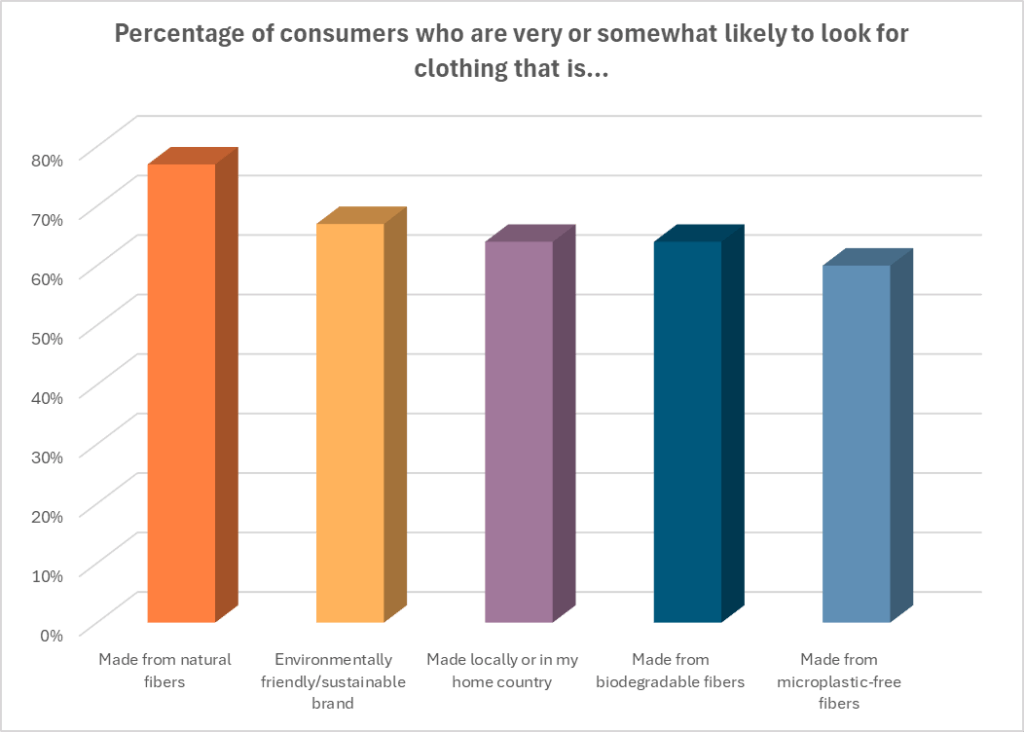
Fully 79 percent of global consumers say sustainability is important when purchasing clothing and 77 percent are likely to look for clothing made from natural fibers, according to the CCI & Cotton Incorporated’s 2026 Global Sustainability Survey of 7,128 consumers across 7 countries. Most shoppers consider cotton (85 percent) and other natural fibers (75 percent) to be safe for the environment, while fewer than half believe manmade fibers, including rayon (43 percent), polyester (43 percent), nylon (43 percent), and Tencel (42 percent) are environmentally safe.
Future designers at New York’s Fashion Institute of Technology are more interested than ever in natural fibers and sustainable apparel design. In fact, FIT’s Mallorie Dunn, professor of fashion design, CCPS and pre-college, says that while the school offers a minor in sustainability and ethics, today’s students have expressed a desire to see sustainability baked into more of their fashion department coursework.
Dunn told the Lifestyle Monitor™ in an interview that when she worked for undergrad studies, she and another colleague made a 15-week slide deck with 5-minute sustainability lessons that could be easily incorporated into their standard foundational classes.
“I taught those lessons to three sections of second-semester sewing students – and they were incredibly thankful for it,” Dunn told the Lifestyle Monitor™.
Student feedback on the sustainability lessons included a note from one student who wrote, “…I had no idea it was this bad. And I feel like it’s important because we are the future of the industry and if no one knows about it, then no one is going to incorporate anything about it in the future.”