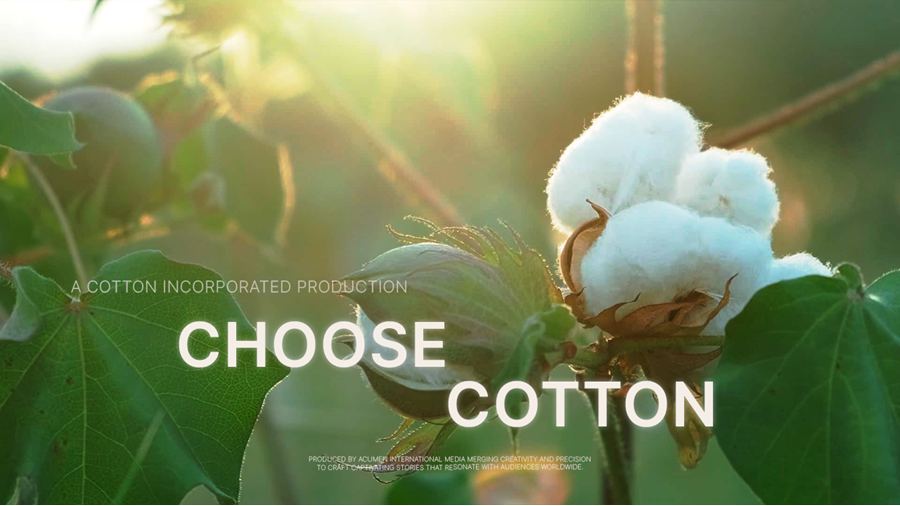
CARY, N.C. (February 17, 2026) As industries around the world transition toward more sustainable supply chains, the global textile sector faces an urgent challenge in how to balance performance, profitability, and environmental responsibility. In this changing landscape, natural fibres like cotton are emerging as essential contributors to a circular and low-impact economy.
Acumen Media is proud to highlight Cotton Incorporated, a not-for-profit organization that for more than five decades has led the scientific and technological innovation of cotton – ensuring that this renewable fiber remains both environmentally and economically viable. Established in 1970, Cotton Incorporated has invested in research and promotion, for more than 50 years, to enhance the performance and sustainability of cotton, from field to finished product.
“Cotton Incorporated’s work spans both research and marketing,” says William Kimbrell, president and CEO for the organization. “We don’t sell cotton, but we strengthen it and we have an unwavering commitment to the farmers who grow it, the manufacturers who transform it, the brands that bring it to life and the consumers who choose it every day.”
Watch the video on CNBC.com.
According to Cotton Incorporated’s Cotton Today, U.S. cotton producers have reduced irrigation water use by 58% per pound of lint produced over the past four decades1. Today, 64% of U.S. cotton requires no irrigation at all, relying solely on rainfall, while only 5% is fully irrigated2. These measurable gains stem from improved soil management, precision agriculture, and efficient irrigation technologies that have allowed U.S. cotton growers to achieve a 25% reduction in greenhouse gas emissions per pound of fiber since 19801.
“Cotton is a fiber that, because of its natural characteristics, has the opportunity to endure and remain relevant even in markets dominated by synthetics,” says Vikki Martin, Ph.D., vice president of fiber competition for Cotton Incorporated.
In its research laboratories, Cotton Incorporated continues to redefine what cotton can do – developing advanced fiber and fabric technologies that enhance durability, moisture management, and resilience while maintaining cotton’s natural biodegradability.
“Cotton Incorporated invests in research and metrics needed to better understand cotton and synthetic fibers in the environment. This information is critical for brands and retailers to source more sustainable fibers and choose cotton,” notes Jesse Daystar, Ph.D., vice president and chief sustainability officer.
Circularity remains central to this vision. From innovations using the whole cotton plant through the Blue Jeans Go Green™ denim recycling program. To date, the program has collected more than 5.9 million pieces of denim and repurposed them into insulation and new materials, preventing millions of pounds of textile waste from entering landfills.
Guided by science and measurable progress, Cotton Incorporated is proving that innovation can sustain tradition – ensuring that natural fibers remain vital to the future of fashion, agriculture, and global trade. As society endeavours to reduce waste and reliance on synthetics, choosing cotton stands as a commitment to a more responsible, sustainable world.
About the organizations
Acumen Media is an award-winning global production company specialising in thought-leadership films and strategic storytelling for the world’s most forward-thinking organisations. Since 2008, Acumen has partnered with companies across sustainability, innovation, infrastructure, and global trade to tell stories that drive understanding and inspire progress.
Cotton Incorporated is the research and promotion company for Upland cotton. Funded by U.S. cotton growers and importers of Upland cotton-containing products, the not-for-profit organization’s mission is to increase the demand for and profitability of cotton. As a resource for the cotton industry, Cotton Incorporated conducts or oversees more than 450 research and educational projects in an average year. Research areas range from the development of agricultural and textile innovations to analyses of commodity and market data.
For more information or to learn more, follow along on LinkedIn, Facebook and X or visit www.CottonToday.com.
Citations:
- Field to Market: The Alliance for Sustainable Agriculture, 2021. Environmental Outcomes from On-Farm Agricultural Production in the United States (Fourth Edition). ISBN: 978-0-578-33372-4. https://fieldtomarket.org/national-indicators-report/
- United States Department of Agriculture National Agricultural Statistics Service. (2019). 2019 Agricultural Statistics. https://quickstats.nass.usda.gov/
United States Department of Agriculture National Agricultural Statistics Service (2023). 2023 Irrigation and Water Management Survey. https://www.nass.usda.gov/Publications/AgCensus/2022/Online_Resources/Farm_and_Ranch_Irrigation_Survey/iwms.pdf