Regenerative agriculture represents a flexible, adaptive land management approach that aims to restore and enhance ecosystem function in ways that reflect the unique physical and environmental conditions of each region.1 This management system works to rebuild natural systems by strengthening soil health, improving watershed function, enhancing biodiversity, and supporting the long-term viability of farm production.1
For cotton, regenerative agriculture means using farming practices that enhance soil health, improve water quality and efficiency, support biodiversity, and build resilience to extreme weather—all while sustaining yields and farm profitability.
What is the foundation of regenerative cotton farming?
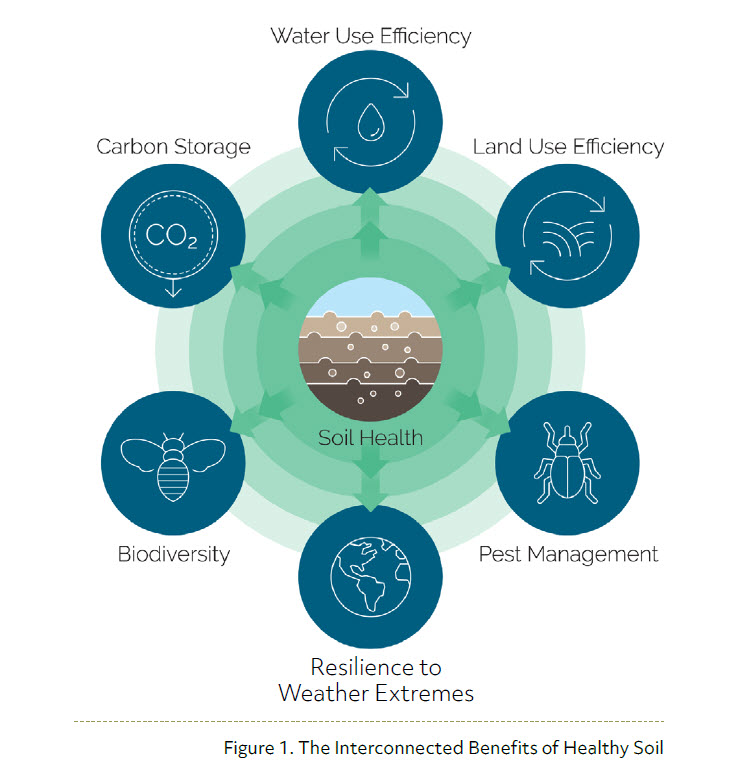
Healthy soil is the foundation of regenerative cotton farming.2 It influences nearly every other aspect of the system—from how efficiently water is used to how much carbon is stored. Regenerative agricultural practices provide growers with a set of tools that can improve soil health, reduce erosion, increase the soil’s organic matter and water holding capacity, boost microbial life, and improve farm profitability.
When soils are healthy, they act like a sponge—holding more water, reducing runoff, improving the efficiency of water, land, and fertilizer use, and storing more carbon.3 Healthy soil makes cotton farms more productive, more resilient to drought and floods, and better for the environment.
At its core, regenerative agriculture is guided by five
interconnected principles1:

Minimize soil
disturbance

Maximize
biodiversity—crops,
soil microbes, and
pollinators

Maintain living
roots in the soil

Integrate livestock
where feasible

Keep soil covered
year-round
How do cotton growers protect and restore soil?
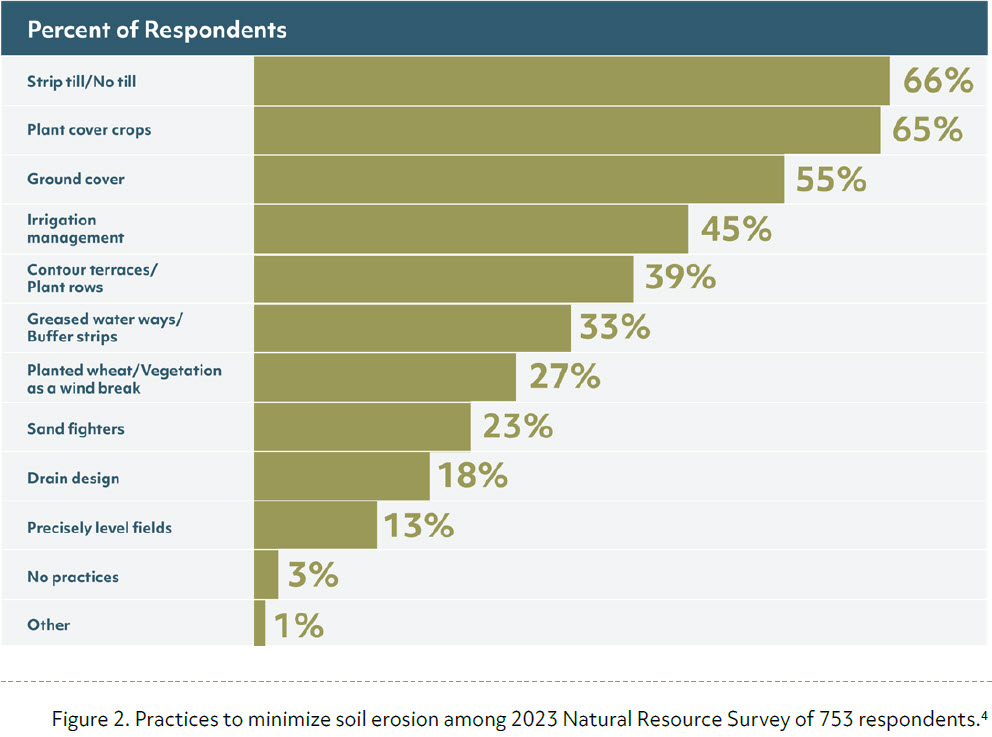
Many U.S. cotton farmers use cover crops, crop rotation, and conservation or no-till practices to protect and build their soils. These methods increase organic matter, improve soil structure, and protect against erosion.
According to the 2023 National Resource Survey of 753 respondents, more than 60% of U.S. cotton farmers reported using both cover crops and strip/no-till to reduce erosion.4 The U.S. Cotton Trust Protocol’s 2024 report found that 78% of its growers are adopting practices that improve soil health and biodiversity.5
Why it matters: For brands and consumers, improved soil health reduces erosion and helps regenerate the land on which cotton depends, thereby contributing to more sustainable sourcing and a long-term fiber supply.
How do regenerative agricultural practices increase water use efficiency and improve water quality?
Regenerative practices can enhance the soil’s ability to capture and store rainfall through two primary mechanisms. First, cover crops slow rainfall runoff, giving water more time to soak into the ground. By holding the soil in place during heavy rainfall, they also reduce erosion, which can limit sedimentation of streams and lakes and directly improves water quality.6
Second, these practices can build healthier soils, improve soil structure, and increase organic matter, allowing the soil to act like a sponge. This enables water to infiltrate deeply rather than puddling and running off. To illustrate the benefit, a mere 1% increase in soil organic matter can boost water storage by over 20,000 gallons per acre.7
Why it matters: Growing cotton with soil health-building practices increases soil organic carbon, thereby improving water-holding capacity and on-farm water use efficiency.
How does regenerative agriculture impact biodiversity on cotton farms?
Regenerative agriculture actively builds biodiversity by increasing the variety of plant life on the farm. Key practices include using multi-species cover crops and crop rotations. This greater plant diversity supports a more varied soil microbiome and provides richer pollinator habitats.8 According to U.S. Cotton Trust Protocol’s 2024 report, 67% of its growers increased efforts to enhance pollinator habitats.
How does regenerative agriculture improve cotton grower’s resilience to extreme weather events?
By improving soil health, optimizing water use, and enhancing biodiversity, regenerative practices help cotton farms withstand drought, flooding, and other climate stresses. Over the past 40 years, U.S. cotton farmers have reduced soil loss by 45%, water use by 58%, and greenhouse gas emissions by 25%.9 Sourcing cotton from growers implementing regenerative practices supports farming systems that are more resilient to droughts and floods, providing greater supply chain stability amid climate volatility.
Can regenerative practices help store carbon?
Regenerative agricultural practices can both reduce emissions as well as provide opportunities for increased carbon sequestration in the soil. Growers implementing nutrient management plans or applying precision fertilization approaches can reduce fertilizer requirements, thereby reducing nitrous oxide emission from both the fertilizer itself and from field emissions. Adopting no-till practices leaves carbon in the soil sequestered. Additional carbon can be drawn from the atmosphere and stored in soil when cover crops are used. The proactive measures taken by U.S. farmers in adopting regenerative practices have resulted in an annual rise of over 8.8 million tons of carbon being stored in cultivated cropland soils, including cotton.10
How does regenerative agriculture improve land use efficiency?
Regenerative cotton production maximizes the productivity of each acre by improving soil health, optimizing water use, and supporting biodiversity. These practices enable cotton growers to maintain yields on existing farmland, reducing the need to convert forests or grasslands for agriculture and helping to preserve natural habitats. Four decades of research shows that U.S. cotton farmers have improved land use efficiency by 30%.9
Is only cotton certified as “regenerative” grown with regenerative practices?
No. Regenerative agriculture is a broad approach that encompasses flexible, outcome-driven farming methods designed to restore soil health, increase biodiversity, improve water quality, and enhance ecosystem resilience. It focuses on tangible results that benefit both the land and the farmer, rather than adhering to fixed inputs or rigid standards.
Regenerative cotton refers to cotton grown using these principles, but it is not limited to certification programs. While certification can provide assurance and transparency, cotton can be considered regenerative based on the practices employed, regardless of formal labeling. In fact, many U.S. producers have been independently implementing regenerative methods for years, achieving measurable environmental improvements without necessarily pursuing certification.
Do “regenerative” and “organic” mean the same in practice?
Although they share some similarities, regenerative agriculture and organic farming are not the same. Regenerative agriculture can be certified or voluntary practices that emphasizes improving the ecological health of farms.11 Organic farming, by contrast, follows specific standards set by the USDA or other certifying bodies, with a primary focus to maintain or improve natural resources and biodiversity. (7 CFR §205.203) While both approaches aim for environmental benefits, their methods and requirements differ.
Why should cotton growers consider regenerative agriculture?
Regenerative agriculture can offer key environmental and economic advantages. By adopting these practices, cotton growers can strengthen their farms’ resilience, profitability, and environmental stewardship. The opportunities and some associated challenges are outlined below.
Opportunities:
Improved Soil Health: Healthier soils retain more water, enabling farmers to better withstand drought and use water more efficiently.
Enhanced Biodiversity: Increased biodiversity provides natural pest control and supports pollinators and wildlife, contributing to a more balanced ecosystem.
Economic Resilience: According to the Soil Health Institute, regenerative practices have resulted in an average increase of $47 per acre in net profits across U.S. commodity farms. This finding is based on five interviews in five states—North Carolina, South Carolina, Georgia, Mississippi, and Texas—which collectively represent approximately 76% of the total cotton produced in the United States.12
Climate Benefits: Regenerative systems capture more carbon and reduce greenhouse gas emissions, helping to mitigate environmental change.
Challenges
Cover Crop Costs: Higher seed costs can create barriers, particularly for specialty cover crops.
Water Limitations: In arid regions, limited water availability can hinder cover crop growth and soil restoration.
Pest Pressures: Reduced pesticide use requires vigilant monitoring and adaptive pest management.
Access to Soil Amendments: Limited supply and cost of compost or manure can constrain soil-building efforts.
Knowledge Gaps: Farmers may lack localized information and training on regenerative methods.
Economic Constraints: Upfront costs for equipment and learning can deter smaller operations.
Risk and Uncertainty: Transitioning practices introduces short-term yield or performance risks.
Resistance to Change: Adoption can be slowed by cultural, structural, or landlord-related barriers.
How do regenerative practices in cotton production benefit the industry?
Regenerative cotton production creates a stronger, more resilient industry by improving soil health, increasing grower profitability, and reducing environmental impacts.
- Field to Market. Defining Sustainable and Regenerative Agriculture. Retrieved September 2025, from https://fieldtomarket.org/defining-sustainability/
- Soil Health Institute. Recommended Measurements for Scaling Soil Health Assessment. Retrieved October 2025, from https://soilhealthinstitute.org/our-work/initiatives/measurements/#overview
- Field to Market. (2021). National Indicators Report: Environmental Outcomes from On-Farm Agricultural Production in the United States (Fourth Edition).https://fieldtomarket.org/media/2021/12/Field-to-Market_2021-National-Indicators-Report_FINAL.pdf
- Bayramova, J., Pires, S., Barnes, E., Morgan, G., Kurtz, R., and Daystar, J. (2024). “Sustainable cotton farming trends: Leveraging natural resource survey insights for U.S. cotton production,” BioResources, 19(4), 7279–7319. https://bioresources.cnr.ncsu.edu/resources/sustainable-cotton-farming-trends-leveraging-natural-resource-survey-insights-for-u-s-cotton-production/
- U.S. Cotton Trust Protocol. (2024). 2023/24 Annual Report. Retrieved September 2025, from https://report.trustuscotton.org/#program-updates
- Thapa, A., Aryal, N., Reba, J., Teague, T., Payne, G, and A. Pieri. 2024. Effects of cover crop and filter strips on sediment and nutrient loads measured at the edge of a commercial cotton field. Journal of
the ASABE 67(2):475-491. https://elibrary.asabe.org/abstract.asp?AID=54672&t=3&dabs=Y&redir=&redirType= - Bryant, L. (2015). Organic Matter Can Improve Your Soil’s Water Holding Capacity. Natural Resources Defense Council. Retrieved September 2025, from https://www.nrdc.org/bio/lara-bryant/organicmatter-can-improve-your-soils-water-holding-capacity
- Soil Health Institute. (2024). Cover Crop Species Comparison for Weed Suppression in Cotton Production. https://soilhealthinstitute.org/app/uploads/2024/07/CoverCropSpeciesComparisonForWeedSuppressionInCottonProduction.pdf
- Field to Market. National Indicators Report. Retrieved September 2025, from https://fieldtomarket.org/national-indicators-report/cotton/
- USDA. (2022). Conservation Practices on Cultivated Cropland: Summary of Findings. https://www.nrcs.usda.gov/sites/default/files/2022-12/ceap-croplands-ConservationPracticesOnCultivatedCroplands-summary-March2022.pdf
- Noble Research Institute. What Is the Difference Between Organic and Regenerative Agriculture?. Retrieved September 2025, from https://www.noble.org/regenerative-agriculture/organic-vsregenerative-agriculture/
- Soil Health Institute. (2022). Economics of Soil Health Management Systems on Five Cotton Farms. https://soilhealthinstitute.org/app/uploads/2022/03/Economics-On-Five-Cotton-Farms.pdf